
Table of Contents
How to Reduce Back Pain in 5 Minutes: Quick Relief Techniques and Long-Term Solutions
When sudden spinal tightness or lower back stiffness strikes during a busy workday, learning how to reduce back pain in 5 minutes can offer crucial temporary comfort. Whether you are a desk worker in an IT corridor sitting through back-to-back meetings, a driver managing long daily commutes, or someone who simply twisted awkwardly while lifting groceries, fast-acting relief techniques can help calm acute muscle guarding.
However, while quick physical adjustments, position changes, and breathing methods can temporarily ease tense back muscles, it is vital to distinguish between momentary relief and long-term structural healing. Understanding how to manage acute discomfort safely in the short term empowers you to take immediate control while preparing you to address any underlying spinal issues with professional care.

What Does 5-Minute Back Pain Relief Do for Your Body?
+-------------------------------------------------------------------------+
|                  THE 5-MINUTE NEUROMUSCULAR PAIN CYCLE                  |
|                                                                         |
|  [ Physical Trigger ] ---> [ Muscle Guarding / Spasm ] ---> [ Pain ]    |
|                                                                    |    |
|  [ Decompression / Breathing ] <--- [ Muscle Relaxation ] <--------+    |
+-------------------------------------------------------------------------+
Techniques for quick back pain relief work by decompressing the spinal column, easing muscle spasms, and calming the central nervous system’s stress response. By shifting positions to reduce intradiscal pressure and taking deep, diaphragmatic breaths, you signal your paraspinal muscles to release acute tension, offering temporary relief from localized tightness.
Quick Temporary Relief vs. Dedicated Interventional Pain Management
When back discomfort flares up, understanding the difference between temporary home strategies and comprehensive medical care ensures you make safe, informed health decisions.
+-----------------------------------------------------------------------------+
|                      TEMPORARY RELIEF vs. INTERVENTIONAL CARE               |
|                                                                             |
|  [ 5-Minute Relief Methods ] ---> Relieves superficial muscle tightness.   |
|  [ Interventional Care ]     ---> Targets specific anatomical generators   |
|                                   (discs, nerves, joints) under imaging.  |
+-----------------------------------------------------------------------------+
While 5-minute physical resets ease superficial muscle fatigue, they cannot repair a bulging intervertebral disc, calm an inflamed sciatic nerve root, or reverse facet joint arthritis. Interventional pain medicine bridges the gap between quick home fixes and invasive surgical options.
Guided by protocols established by the International Association for the Study of Pain (IASP) and the Indian Society for Study of Pain (ISSP), an interventional pain doctor uses live image-guided techniques to diagnose and treat the precise anatomical source of pain, offering lasting functional restoration rather than temporary symptom masking.
How to Reduce Back Pain in 5 Minutes: 5 Step-by-Step Techniques
If you are currently experiencing non-emergency lower back tightness, follow these step-by-step physical techniques to ease muscle strain safely in five minutes or less:
  +------------------------------------------------------------------+
  | STEP 1: The Constructive Rest Position (90-90 Decompression)    |
  +------------------------------------------------------------------+
                                   |
                                   v
  +------------------------------------------------------------------+
  | STEP 2: Diaphragmatic Box Breathing (De-escalate Nervous System)  |
  +------------------------------------------------------------------+
                                   |
                                   v
  +------------------------------------------------------------------+
  | STEP 3: Gentle Cat-Cow Spinal Articulation                       |
  +------------------------------------------------------------------+
                                   |
                                   v
  +------------------------------------------------------------------+
  | STEP 4: Supported Child’s Pose (Lumbar Flexion Stretch)          |
  +------------------------------------------------------------------+
                                   |
                                   v
  +------------------------------------------------------------------+
  | STEP 5: Standing Lumbar Extension Reset                          |
  +------------------------------------------------------------------+
1. The Constructive Rest Position (90-90 Decompression)
Lie flat on your back on a firm surface or yoga mat. Rest your calves onto the seat of a chair or couch so your hips and knees are bent at 90-degree angles. This position immediately unloads weight from the lumbar spine and reduces intradiscal pressure. Hold this position for 2 to 3 minutes.
2. Diaphragmatic Box Breathing
While in the constructive rest position, place one hand on your chest and the other on your abdomen. Inhale slowly through your nose for 4 seconds, feeling your stomach rise. Hold for 4 seconds, exhale through your mouth for 4 seconds, and hold empty for 4 seconds. Repeat this cycle 5 times to reduce nervous system tension and relax tight paraspinal muscles.
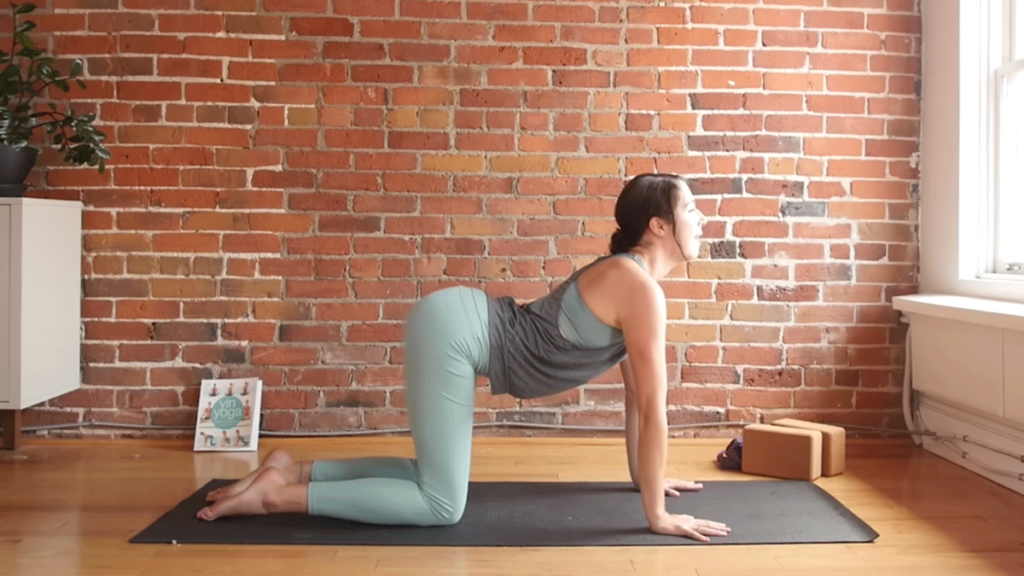
3. Gentle Cat-Cow Spinal Articulation
Transition to your hands and knees on a soft surface. Inhale as you gently arch your lower back, bringing your chest forward (Cow). Exhale as you round your spine toward the ceiling, tucking your chin slightly (Cat). Move fluidly between these two positions 5 to 8 times, keeping movements smooth and pain-free.
4. Supported Child’s Pose (Lumbar Flexion Stretch)
From your hands and knees, widen your knees slightly and sink your hips back toward your heels. Extend your arms forward on the floor and rest your forehead gently on a cushion or mat. Breathe deeply into your lower back for 60 seconds to lengthen tight lower back muscles and relieve compression.
5. Standing Lumbar Extension Reset
Stand upright with feet shoulder-width apart. Place the palms of your hands against your lower back just above your hips, with fingers pointing down. Gently lean your upper body backward a few degrees while supporting your lower back. Hold for 3 to 5 seconds, return to upright, and repeat 3 times. This helps counteract the forward-slouched posture of desk work.
Safety Precaution: If any of these movements cause sharp, shooting pain down your leg, numbness, or increased discomfort, stop immediately and return to a comfortable resting position.
Comparing Short-Term Relief Methods vs. Advanced Medical Interventions
Understanding when home techniques are sufficient—and when specialized medical care is needed—helps ensure your long-term health and mobility.
| Feature / Criteria | 5-Minute Home Relief Techniques | Advanced Interventional Pain Care |
| Primary Goal | Temporary relaxation of tight paraspinal muscles | Direct treatment of underlying anatomical pain sources |
| Target Structures | Superficial muscles and nervous system tension | Intervertebral discs, facet joints, sciatic nerve roots |
| Duration of Relief | Short-term (minutes to hours) | Extended (months to years, depending on procedure) |
| Diagnostic Accuracy | Symptom-based; does not pinpoint structural causes | Image-guided diagnostic mapping (Fluoroscopy/Ultrasound) |
| Clinical Indication | Minor posture fatigue, mild muscle stiffness | Persistent pain (>4–6 weeks), sciatica, nerve compression |
Who Should Explore Long-Term Interventional Pain Solutions?
While knowing how to reduce back pain in 5 minutes is valuable for managing momentary stiffness, quick stretches are not a permanent solution for chronic or recurring spinal issues.
+-----------------------------------------------------------------------------+
|                      WHEN TO SEEK SPECIALIZED CARE                          |
|                                                                             |
|  - Pain lasts longer than 4 to 6 weeks despite rest.                        |
|  - Pain radiates down into the buttock, thigh, or calf (Sciatica).           |
|  - Morning stiffness makes getting out of bed difficult.                    |
|  - You rely on daily over-the-counter pain relievers.                        |
|  - Discomfort restricts work, travel, or family life.                       |
+-----------------------------------------------------------------------------+
You may be an ideal candidate for specialized, non-surgical pain relief if:
- Your back discomfort returns repeatedly as soon as short-term stretches wear off.
- Physical therapy exercises trigger sharp flare-ups rather than providing relief.
- You experience radiating pain, tingling, or electric-shock sensations down your leg.
- You want to avoid major spinal surgery or have been advised that open surgery is not strictly necessary.
What to Expect During an Interventional Pain Evaluation
If persistent back pain continues to interfere with your daily life, visiting a dedicated pain clinic provides a clear, structured path forward.
+-----------------------------------------------------------------------------+
|                        THE PATIENT CARE JOURNEY                             |
|                                                                             |
|  [ Diagnostic Evaluation ] ---> [ Image-Guided Mapping ]                   |
|                                         |                                   |
|  [ Functional Rehabilitation ] <--- [ Day-Care Treatment ] <----------------+
+-----------------------------------------------------------------------------+
1. Comprehensive Clinical Examination
Your evaluation begins with a detailed assessment of your movement patterns, spinal flexibility, reflex health, and a thorough review of past MRI or X-ray scans.
2. Precision Image-Guided Diagnostic Mapping
Unlike standard physical exams, an interventional specialist uses live C-arm fluoroscopy or high-resolution ultrasound guidance to perform diagnostic nerve blocks, accurately confirming the exact joint or disc driving your discomfort.
3. Targeted Outpatient Procedures
Once the source is identified, minimally invasive day-care therapies—such as epidural steroid injections, radiofrequency ablation, or platelet-rich plasma (PRP) therapy—are performed under local anesthesia, allowing you to return home the same day.
4. Functional Rehabilitation
With your baseline pain significantly reduced, you can safely complete targeted physical therapy to rebuild core strength, protect your spine, and prevent future pain flare-ups.
When Should You See a Pain Management Specialist?
If you have been managing chronic back pain for more than six weeks with limited relief from medication or physiotherapy, a consultation with a fellowship-trained interventional pain specialist is the logical next step.
In Hyderabad, Dr. P. Purohithi at Meraki Pain Management Center, located within Apollo Hospital, Kondapur, specializes in precisely diagnosing and treating the source of your pain using image-guided, minimally invasive techniques—without defaulting to surgery. Holding a Fellowship in Interventional Pain Medicine (FIPM) and expertise in ultrasound-guided pain medicine (IDRA), Dr. Purohithi focuses on safe, evidence-based care tailored to each patient’s needs.
Frequently Asked Questions (FAQs)
1. Is it safe to try quick stretches when my back pain is acute?
Gentle decompression positions like constructive rest or mild child’s pose are generally safe for simple muscle fatigue. However, if any stretch causes sharp, shooting pain down your leg or worsens your discomfort, stop immediately and seek professional evaluation.
2. Why does my back pain return even after I stretch and rest?
Stretching relaxes surface muscles, but it does not fix structural issues like a bulging disc, an inflamed facet joint, or nerve compression. When the underlying cause remains unaddressed, paraspinal muscles tighten up again to protect the spine.
3. How do I know if I need a pain management specialist or a spine surgeon?
If your back pain persists despite rest and basic medication, but you do not have severe surgical red flags—such as progressive leg paralysis or loss of bowel and bladder control—a pain management specialist provides non-surgical, image-guided therapies that often eliminate the need for surgery.
4. Are interventional treatments like epidural injections or nerve blocks safe?
Yes, when performed by a qualified interventional specialist using live image guidance (fluoroscopy or ultrasound), procedures such as epidural steroid injections and nerve blocks have a strong safety record and are performed routinely in outpatient day-care settings.
5. Can I get non-surgical back pain treatment as a day-care procedure in Kondapur, Hyderabad?
Yes, at Meraki Pain Management Center within Apollo Hospital, Kondapur, most interventional pain treatments performed by Dr. P. Purohithi are day-care procedures, allowing patients to return home safely after a brief observation period.
6. How long does pain relief last after an interventional procedure like radiofrequency ablation?
While response times vary, clinical experience indicates that targeted procedures like radiofrequency ablation (RFA) can provide substantial pain reduction typically lasting from 6 to 18 months, giving patients an extended window for functional rehabilitation.
7. How much does an interventional pain consultation cost in Hyderabad?
Consultation costs vary based on the clinical setting and individual diagnostic needs. Seeking care within an established facility like Apollo Hospital, Kondapur ensures transparent pricing and access to advanced diagnostic infrastructure.
8. Will health insurance cover interventional back pain treatments?
Many health insurance policies in India cover medically necessary day-care interventional pain treatments when performed in an accredited hospital facility like Apollo Hospital, Kondapur. It is recommended to check your specific policy terms.

Moving Beyond Quick Fixes to Lasting Spine Health
Knowing how to reduce back pain in 5 minutes offers a useful tool for managing temporary muscle tightness during a busy day. However, achieving lasting mobility and living free from persistent pain requires addressing the underlying cause of your symptoms.
If you are considering advanced, non-surgical pain management options in Hyderabad, Dr. P. Purohithi at Meraki Pain Management Center, Apollo Hospital, Kondapur, offers thorough diagnostic consultations before recommending any personalized care plan.



Leave a Comment